
SJT Textbook: Situations with No Perfect Option
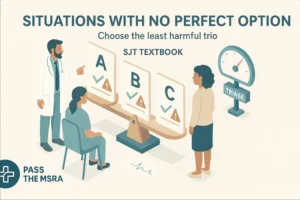
Situations with No Perfect Option MSRA
This guide addresses the most uncomfortable format in the exam: Situations with No Perfect Option MSRA scenarios. In the Professional Dilemmas paper, you will face “Wicked Problems” where every choice carries risk. The test is not about finding a magical fix, but about demonstrating damage control.
🎥 Video Lesson (YouTube)
🎧 Podcast Lesson (Spotify / Apple / Amazon)
FREQUENCY: High
PRIORITY: Must-Know
🎯 THE CORE PRINCIPLE
Some MSRA SJT vignettes deliberately present scenarios where *all* available actions have limitations. The task is not to find a perfect answer, but to choose the least harmful, most defensible actions in line with GMC Good Medical Practice.
These questions emphasise harm minimisation: early assessment of risk, proportionate information sharing, escalation to seniors, and careful documentation. Doing nothing, delaying action, or taking extreme responses usually scores poorly.
The common exam trap is overreacting (e.g., unnecessary confrontation or breach of confidentiality) or underreacting (e.g., delaying safeguarding, avoiding escalation, failing to document).
These items test your ability to balance competing risks where time, information, and consent may be incomplete. The highest-scoring actions show proportionate safeguarding, calm enquiry, and clear reasoning.
⚡ HIGH-YIELD ACTIONS (What Scores Points)
1. Prioritise immediate safety and actively assess risk rather than delaying.
2. Create privacy to enable honest disclosure when coercion is suspected.
3. Use calm, non-judgemental questioning to gather essential information.
4. Share information lawfully and proportionately when there is real risk of harm.
5. Escalate to senior clinicians or safeguarding teams early.
6. Document concerns, assessments, and the legal/ethical basis for decisions.
7. Offer support routes discreetly (leaflets, helplines, follow-up).
8. Avoid actions that worsen risk, shame the patient, or compromise confidentiality.
9. Check understanding and agree next steps where feasible.
10. Maintain professional boundaries even under pressure.
• Unsafe delay when risk of harm is present.
• Failure to document concerns or rationale.
• Ignoring opportunities to seek privacy for a vulnerable patient.
• Sharing information excessively or through insecure channels.
• Confrontational or disproportionate escalation.
These traps typically avoid enquiry, avoid documentation, breach confidentiality, or escalate without proportionality.
💬 MODEL PHRASES (Use These in SJT Logic)
* “Can you tell me in your own words what happened?”
* “I’m concerned there may be risk; I may need to share information to keep you safe.”
* “I’ll record what we’ve discussed and the reasons for my actions today.”
* “Let’s talk through support options that are available.”
* “I’ll involve senior/safeguarding colleagues to ensure the right support.”
Speak privately • Assess risk • Facilitate disclosure • Escalate appropriately • Information-share lawfully • Take clear notes
Create privacy to allow safe conversation.
Ask open, non-leading questions.
Assess immediate and future risk.
Share information proportionately if risk is significant.
Escalate early (senior/safeguarding).
Document concerns, actions and reasons.
Arrange follow-up and support discreetly.
📋 QUICK FAQ
Do I need consent to share safeguarding concerns?
No—if risk of serious harm exists, you may share proportionately without consent. Document your justification.
Should I confront the partner directly?
No. This increases risk and breaks confidentiality boundaries.
What if the patient denies abuse?
You should still record concerns, assess risk, offer support, and share information if required for safety.
Is delaying action acceptable to avoid upsetting the patient?
No. Safety overrides discomfort. Delay is a common exam error.
What about cultural sensitivity?
Respect culture, but safeguarding always comes first when someone is at risk.
📚 GMC ANCHOR POINTS
• Protect patients and respond to safety concerns (GMC Good medical practice 2024).
• Share information appropriately for safety (Confidentiality guidance).
• Listen, communicate clearly, and show respect (GMC Communication).
• Record work clearly and accurately (GMC Record Keeping).
• Work collaboratively and escalate when needed (GMC Teamworking).
💡 MINI PRACTICE SCENARIO
A woman presents with bruises. Her partner answers all questions for her and refuses to leave the room.
Best action: Find a safe reason to speak to her alone and assess risk directly.
Why: Privacy enables disclosure; safeguarding requires direct assessment and proportionate information sharing.
🎯 KEY TAKEAWAYS
✓ When all options are flawed, pick the *least harmful* and most transparent.
✓ Privacy is essential when coercion is suspected.
✓ Proportionate information sharing is lawful when risk exists.
✓ Early escalation prevents future harm.
✓ Documentation protects the patient and you.
✓ Avoid delay, confrontation, or secrecy.
🔗 RELATED TOPICS
* → Safeguarding Adults
* → Domestic Abuse & Coercive Control
* → Information Sharing (Safeguarding)
* → Professional Boundaries
* → Equity & Accessibility
📖 FULL PRACTICE QUESTIONS
Example SJT — Best of 3 (8 options; choose three)
A woman attends with bruising on her upper arm. She says she “fell”, but her partner answers every question for her and keeps interrupting. She avoids eye contact and appears anxious.
Options:
A. Find a reason to speak with her alone
B. Ask direct, non-judgemental questions about safety
C. Do not document anything to protect privacy
D. Share information without consent if serious harm risk is identified
E. Book routine follow-up in 4 weeks
F. Call security to remove the partner immediately
G. Tell the partner to answer fewer questions
H. Ignore concerns if she denies harm
Correct three: A, B, D
• A: Enables private disclosure and risk assessment.
• B: Skilled enquiry promotes safety and support.
• D: Lawful safeguarding if risk is real and consent is not safe.
Why others are weaker/wrong:
• C: No documentation = unsafe.
• E: Delay without assessment.
• F: Disproportionate escalation.
• G: Ineffective; does not enable privacy.
• H: Denial does not remove safeguarding duty.
Example SJT — Rank 5 (best → worst)
A woman presents with facial bruising. Her partner insists on answering all questions and becomes irritated when asked to wait outside.
Options:
A. Create a reason to speak to her alone
B. Ask direct, non-leading questions once alone
C. Document concerns and rationale clearly
D. Book a routine review without further action
E. Ignore concerns because there is no disclosure
Ideal order: A (1) > B (2) > C (3) > D (4) > E (5)
• A: Privacy first allows disclosure and reduces risk.
• B: Non-judgemental enquiry follows best practice safeguarding.
• C: Documentation ensures an audit trail of risk and reasoning.
• D: Delay without assessment risks missing harm.
• E: Ignoring concerns is unsafe and contrary to guidance.
Minimise harm through privacy, enquiry and proportionate action
Escalate early when risk is identified
Document concerns and rationale clearly
Ignoring signs of coercion or abuse
Delaying safeguarding due to uncertainty
Promising secrecy before assessment
- GMC — Good medical practice (2024)
https://www.gmc-uk.org/-/media/documents/good-medical-practice-2024—english-102607294.pdf - GMC — Confidentiality: good practice in handling patient information
https://www.gmc-uk.org/ethical-guidance/ethical-guidance-for-doctors/confidentiality - NHS England — Domestic Abuse: Professional Guidance
https://www.england.nhs.uk/publication/domestic-abuse-guidance/ - UK Government — Controlling or Coercive Behaviour Statutory Guidance
https://www.gov.uk/government/publications/controlling-or-coercive-behaviour