SJT Textbook: Responding to Patient Complaints
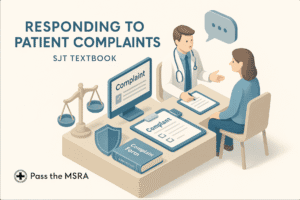
Patient Complaints MSRA SJT guide
This Patient Complaints MSRA SJT guide covers the essential steps for de-escalating conflict in the exam. In the Professional Dilemmas paper, candidates often struggle with the fear that saying “sorry” implies legal guilt. This guide clarifies exactly how to handle that balance.
🎥 Video Lesson (YouTube)
🎧 Podcast Lesson (Spotify / Apple / Amazon)
FREQUENCY: High
PRIORITY: Must-Know
🎯 THE CORE PRINCIPLE
Responding to patient complaints is about taking concerns seriously, protecting patients from further harm, and maintaining trust through openness and candour. A good response starts with checking that the patient is clinically safe, then moves to listening carefully, acknowledging distress, and apologising where care, communication or expectations have fallen short. A sincere apology is the right thing to do and is not in itself an admission of legal liability.
You then give an honest, clear account of what you know so far and what you will do to find out more, including timescales and who will be involved. Patients should be offered clear routes for feedback and formal complaints, such as PALS and the local complaints service, with realistic expectations about response times. Finally, you document the concern factually, file an incident where safety is (or could be) affected, and feed learning back into the team and organisation.
In MSRA SJT questions, high-scoring options combine safety, empathy, apology, explanation, signposting and documentation. Low-scoring ones are defensive, minimising, blaming others, or vague about what will happen next, or they fail to record or escalate issues that could affect safety.
In Patient Complaints MSRA SJT questions, you must understand the hierarchy of resolution. It usually flows from Local Resolution (You) → PALS → Formal Complaint → Ombudsman.
⚡ HIGH-YIELD ACTIONS (What Scores Points)
1. Check and stabilise any immediate clinical risk before doing anything else.
2. Invite the patient or relative to explain their concerns; listen actively and acknowledge their distress.
3. Offer a clear, sincere apology where care, communication or expectations have fallen short.
4. Share what you know so far, avoid speculation, and explain what you will do to investigate and when they can expect an update.
5. Signpost to PALS and the local complaints team, offering practical help to access these routes if they wish.
6. Make a factual, contemporaneous record of the conversation, including key concerns, actions agreed and contact details.
7. Submit an incident report if safety was, or could have been, compromised, so that systemic learning can occur.
8. Inform or involve an appropriate senior (for example consultant, duty manager) where the issue is serious or recurring.
9. Ensure the complaint does not negatively affect the ongoing care you provide to the patient or family.
• Possible safeguarding concerns, serious harm, or near miss affecting patient safety.
• Clear breach of confidentiality or data protection (for example wrong letters, overheard details).
• Aggression, threats or behaviour risking staff or patient safety (follow local safety and security policies).
• Repeated similar complaints or incidents suggesting a system-level failure.
Trap answers tend to minimise the concern, avoid apology, shift blame to other services, or give vague promises without clear routes or timescales. In the exam, choose options that show openness, empathy, realistic next steps, proper signposting and documentation.
💬 MODEL PHRASES (Use These in SJT Logic)
* “From what you have described, I can see why you are upset. I will look into this today and let you know what I find by [timeframe].”
* “If you would like to make a formal complaint, PALS and our complaints team can support you; I can give you their details and help you contact them.”
* “I will document your concerns and submit an incident report because safety could have been affected, so the team can review and learn from this.”
* “Your ongoing care will not be affected by raising a complaint; you are entitled to raise concerns and be treated respectfully.”
Risk-safe • Empathise • Provide apology • Account next steps • Inform routes • Record and learn.
Use REPAIR to remember the sequence: make things safe, listen and acknowledge, say sorry, explain what will happen, signpost to PALS/complaints, and document for learning.
Check immediately for any ongoing clinical risk and act to make care safe.
Invite the patient or relative to describe their concern and respond with clear empathy.
Offer a sincere apology and give a factual explanation of what is known so far.
Explain what you will do next, who will be involved, and when they can expect an update.
Provide PALS/complaints details and help them access these routes if they wish.
Document the discussion objectively and submit an incident report if safety is, or could be, affected.
📋 QUICK FAQ
Is apologising risky from a legal perspective?
No. The GMC and NHS Resolution are clear that a sincere apology is the right thing to do and is not in itself an admission of legal liability. It supports candour and trust.
Where should I signpost patients who want to complain?
To PALS (for advice, informal resolution and support) and the organisation’s formal complaints process, usually via the complaints team. Explain how to contact them and typical timescales.
Do I always need to file an incident report as well?
If safety was, or could have been, affected (for example a delay, omission, miscommunication, or near miss), you should file an incident report so that the issue can be reviewed and learning can be captured.
What if I do not know all the facts yet?
Be honest about what you do and do not know. Apologise, explain what you will do to find out more, who will be involved, and when you will update them. Avoid speculation or blaming.
Can a complaint affect the care I provide?
No. GMC guidance states that a complaint must not adversely affect the care you provide. You remain responsible for providing safe, respectful care regardless of the complaint.
📚 GMC ANCHOR POINTS
• Openness and candour: Be open and honest when things go wrong; put matters right where you can, offer an apology, and explain fully (GMC Good Medical Practice 2024, paragraph on candour).
• Responding to complaints: Respond to complaints promptly, fully and honestly, and ensure that care is not adversely affected by a complaint (GMC Good Medical Practice 2024, paragraphs on complaints).
• Raising and acting on concerns: Take appropriate action if you identify risks to patient safety, including reporting incidents and escalating concerns (GMC Raising and acting on concerns about patient safety).
• Records: Keep clear, accurate and contemporaneous records, including significant discussions and agreed actions (GMC Good Medical Practice 2024, records section).
To score highly in Patient Complaints MSRA SJT ranking questions, you must prioritise immediate clinical safety before addressing the emotional distress.
💡 MINI PRACTICE SCENARIO
A patient’s parent is angry that no one called about their child’s critical INR result overnight. The child is currently stable on the ward. The parent wants to know how this happened, who is responsible, and how to complain.
Best action: Check that the child’s care is currently safe, then invite the parent to explain their concerns, apologise sincerely, explain what you know so far, describe how you will investigate and when you will update them, provide PALS/complaints contact details, and document the discussion and an incident for review.
Why: This combines immediate safety, empathy, apology, explanation, clear next steps, proper signposting, and documentation, in line with GMC candour and NHS complaint-handling standards.
🎯 KEY TAKEAWAYS
✓ Safety first: stabilise and escalate any ongoing risk linked to the complaint.
✓ Listen, empathise and apologise; complaints are about emotion as well as facts.
✓ Share what you know, explain what you will do, and give realistic timescales.
✓ Signpost clearly to PALS and the formal complaints process and offer practical help.
✓ Record the concern objectively and file an incident where safety is, or could be, affected.
✓ Complaints must never reduce the quality or respectfulness of the care you provide.
Be alert for these Patient Complaints MSRA SJT red flags. If a complaint involves safeguarding or staff abuse, the standard “listen and apologise” approach changes to “protect and escalate.”
🔗 RELATED TOPICS
* → Duty of Candour
* → Incident Reporting (LFPSE / PSIRF)
* → Speaking Up / Whistleblowing
* → Safe Handover
* → Professional Communication and Apology
📖 FULL PRACTICE QUESTIONS
Example SJT — Best of 3 (8 options; choose three)
Scenario
You are an ST3 in acute medicine. A patient’s partner explains that they waited over 10 hours in the emergency department without clear updates. They feel ignored, say “no one told us what was happening”, and ask how to complain. The patient is now clinically stable. You have a few minutes before the consultant ward round.
Options:
A. Apologise for their experience, briefly summarise what you know about the delay, explain what you will do to clarify events, and provide PALS/complaints contact details, offering to help them make contact.
B. Explain that the department is always busy, that “these things happen”, and suggest they email the hospital if they are still unhappy.
C. Tell them that any complaints must go directly to the chief executive and that you cannot advise further.
D. Apologise, listen to their concerns in more detail, explain that delays are being reviewed locally, and offer to escalate their feedback to the duty manager as well as giving PALS details.
E. Tell them that as a trainee you cannot get involved in complaints and they should “take it up with management”.
F. Say that you understand their frustration but you do not have time to discuss it now and walk away.
G. Offer to write down their concerns in the notes but give no information on how they can complain or what will happen next.
H. Tell them you will “sort it out” personally and guarantee that they will receive a full written apology within 24 hours, even though you are unsure of the process or timescales.
Correct three: A, D, G
• A: Provides apology, empathy, an outline of what is known, and clear signposting with practical help; strongly aligned with GMC and NHS expectations.
• D: Builds on A by listening further, acknowledging system issues, and offering escalation to a duty manager, while still providing formal routes.
• G: At least captures their concerns in the record and signals that the complaint is being noted, though it is weaker without explicit signposting; acceptable as a “third best” when combined with A and D.
Why others are weaker/wrong:
• B: Minimises the concern and offers vague signposting, without ownership or clear next steps.
• C: Incorrectly restricts complaint routes and is unhelpful.
• E: Inappropriately refuses involvement; all doctors have responsibilities around complaints and candour.
• F: Abruptly ends the conversation, disregarding the partner’s distress and failing candour.
• H: Makes unrealistic promises outside your control, risking further loss of trust if not met.
Example SJT — Rank 5 (best → worst)
Scenario
You are a GP registrar in clinic. A patient is angry that their abnormal potassium result was not communicated for 48 hours. They found out only when attending an unrelated appointment. They are now stable, but they state they have “lost all trust in the practice”, want to know “who is to blame”, and ask how to escalate the issue.
Options:
A. Acknowledge their distress, apologise sincerely, check their current clinical status and arrange any urgent follow-up needed, explain what you know so far, outline how you will investigate the delay, give PALS/complaints details and expected timescales, and document the consultation and an incident.
B. Explain that results are often delayed due to staff shortages and that “everyone is under pressure”, and suggest they email the generic practice address if they want to complain.
C. Say you cannot discuss responsibility because you were not on duty at the time, and advise them to “take it up with management”.
D. Immediately give the name of the receptionist who filed the result and suggest they complain specifically about that staff member.
E. Avoid apologising in case it is “admitting fault”, tell them that “these things happen”, and move on to the next patient.
Options:
A. Full safety check, apology, explanation, formal routes, and documentation.
B. Partial explanation with vague signposting and no ownership.
C. Deflects responsibility and offers no practical support.
D. Blames an individual without proper review; unprofessional.
E. Minimises the issue, avoids apology, and fails to address safety or process.
Ideal order: A (1) > B (2) > C (3) > D (4) > E (5)
• A: Best; combines safety check, empathy, apology, explanation, clear investigation plan, signposting and documentation, fully aligned with GMC and NHS complaint standards.
• B: Second-best; at least acknowledges system pressure and offers a route, but is vague, defensive, and lacks apology or clear plan.
• C: Deflects and offers little support, but is less harmful than blaming an individual or dismissing the concern entirely.
• D: Inappropriately targets a named staff member without proper review, risking unfair blame and poor culture.
• E: Worst; avoids apology and minimises the problem, fails to address safety or learning, and undermines trust.
Make care safe first (check for ongoing risk)
Listen, empathise and offer a sincere apology
Explain what you know and what you will do next, with timescales
Signpost clearly to PALS and the complaints process
Document the concern; file an incident if safety is or could be affected
Ongoing clinical risk or deterioration
Confidentiality or data protection breach
Recurrent similar incidents suggesting system failure
Aggression or behaviour risking staff or patient safety
- GMC — Good medical practice (2024)
https://www.gmc-uk.org/professional-standards/good-medical-practice-2024 - GMC — Raising and acting on concerns about patient safety
https://www.gmc-uk.org/professional-standards/professional-standards-for-doctors/raising-and-acting-on-concerns - NHS England — Give feedback or make a complaint about an NHS service
https://www.england.nhs.uk/contact-us/feedback-and-complaints/complaint - NHS — What is PALS?
https://www.nhs.uk/nhs-services/hospitals/what-is-pals-patient-advice-and-liaison-service - PHSO — NHS Complaint Standards
https://www.ombudsman.org.uk/organisations-we-investigate/complaint-standards/nhs-complaint-standards - NHS Resolution — Saying Sorry
https://resolution.nhs.uk/resources/saying-sorry